


Leaf Blower Types: Battery, Gas, Handheld, and Backpack
The leaf blower category splits on two axes: power source (battery vs gas vs corded electric) and form factor (handheld vs backpack). Most buyers choose across both axes simultaneously — the right combination depends on yard size, budget, and tolerance for noise and maintenance.
Battery Leaf Blowers
Battery leaf blowers have become the dominant choice for residential use over the past few years, driven by rapidly improving performance and increasing noise restrictions on gas. Modern 56V (EGO) and 80V (Greenworks) systems deliver 500–730 CFM — equivalent to or exceeding most handheld gas blowers — with dramatically reduced noise (65–75 dB vs 94–100 dB for gas), zero exhaust, instant start, and near-zero maintenance. For most suburban lots with seasonal leaf clearing, a quality battery blower is the correct choice.
EGO Power+ LB5804 56V 580 CFM Cordless Leaf Blower with 5.0Ah Battery
- ✓ 580 CFM / 168 MPH — Turbo boost mode for heavy debris
- ✓ 56V ARC Lithium 5.0Ah — 75 min runtime at low speed
- ✓ 65 dB at operator — one of the quietest high-performance blowers
- ✓ Weather-resistant + LED light for low-light use
Precio en Amazon.es · LATAM: comprueba tu Amazon local
Gas Leaf Blowers
Gas leaf blowers remain the go-to for professional landscapers, large properties, and applications requiring sustained high power for 4+ hours. Handheld gas blowers (25–35cc) deliver 400–500 CFM — surprisingly similar to a mid-range battery blower — but with unlimited runtime. Backpack gas blowers (50cc+) reach 600–800+ CFM with dramatically better sustained performance over full workdays. The trade-off is noise (94–100 dB requiring hearing protection), exhaust, fuel mixing for 2-stroke models, and carburetor maintenance.
Handheld vs Backpack
Handheld blowers (battery and gas) suit most residential applications: clearing a driveway, patio, or quarter-acre lot. The weight (3–8 lbs) is manageable in one hand for 30–60 minute sessions. Backpack blowers distribute a heavier unit (15–25 lbs) across the shoulders and back, making sustained 2–4 hour sessions feasible — necessary for professional use or large properties with extensive tree coverage. Battery backpack blowers exist (EGO LB6002, Greenworks) but at premium prices. For a homeowner who spends an hour clearing leaves twice per year, a handheld battery blower is the right tool.
Buying Guide: CFM, MPH, and Noise
CFM vs MPH: Which Matters More?
CFM (cubic feet per minute) is the more important spec for leaf blowing. It measures the volume of air the blower moves per minute — more volume means larger surface coverage per pass and more effective displacement of leaf piles. MPH measures the velocity of the air stream at the nozzle tip — high velocity is useful for dislodging stuck or wet debris but does little extra once leaves are already airborne.
A practical benchmark: 400–450 CFM moves dry leaves on flat surfaces adequately. 500–550 CFM handles wet leaves, damp grass clippings, and clearing from corners. 600+ CFM is where work genuinely accelerates on large properties — thick leaf mats move in a single pass. The EGO LB5804 at 580 CFM is near the top of the residential battery category; the Greenworks 40V at 550 CFM is an excellent mid-range option.
Noise Levels and Local Regulations
Gas leaf blower noise (94–100 dB) has triggered legislation across the US. California passed SB 1346 banning sales of new gas-powered small off-road engines (including leaf blowers) after January 1, 2024. Many cities and municipalities restrict gas blower use during early morning, evening, and weekends regardless of state law. Before purchasing a gas blower, check your local noise ordinances. Battery blowers (65–75 dB) operate below the threshold of most regulations and are significantly more neighbor-friendly regardless of legal requirements.
Top Leaf Blower Picks for 2026
For detailed comparisons, see our dedicated guides:
- Best Battery Leaf Blowers 2026 — EGO LB5804, DEWALT DCBL722P1, and Greenworks 40V
- Best Gas Leaf Blowers 2026 — Husqvarna 350BT backpack and handheld options

DEWALT DCBL722P1 20V MAX 450 CFM Cordless Leaf Blower Kit
- ✓ 450 CFM / 125 MPH — brushless motor for max efficiency
- ✓ 20V MAX 5.0Ah battery included — shares with DEWALT tool platform
- ✓ Variable speed trigger + cruise control for sustained operation
- ✓ 4.7 lbs — one of the lightest high-performance cordless blowers
Precio en Amazon.es · LATAM: comprueba tu Amazon local
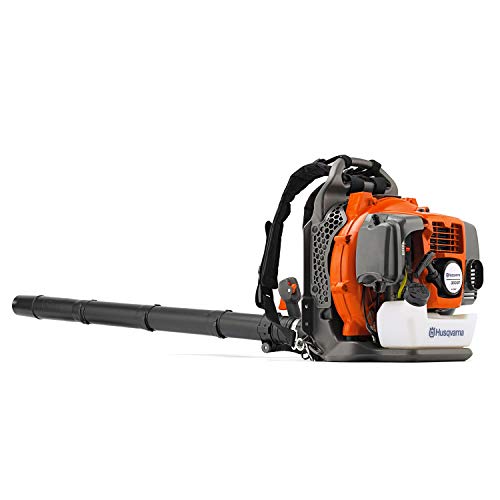
Husqvarna 350BT 50.2cc Gas Backpack Leaf Blower, 692 CFM 180 MPH
- ✓ 50.2cc 2-stroke engine — 692 CFM / 180 MPH
- ✓ Backpack harness distributes weight for all-day use
- ✓ X-Torq engine: 60% lower exhaust emissions vs older designs
- ✓ Cruise control lever + anti-vibration system
Precio en Amazon.es · LATAM: comprueba tu Amazon local
Uses Beyond Leaves: What Else Can a Blower Do?
Leaf blowers are among the most versatile yard tools despite the single-task name. A blower is effective for: clearing grass clippings from sidewalks, driveways, and patios after mowing (much faster than sweeping); drying off a car after washing; clearing snow from cars and light powdery snow from walks before it packs down; blowing debris from rain gutters (with a gutter attachment); cleaning sawdust from workshop spaces; drying damp areas before painting or caulking; and blowing out window wells and outdoor storage spaces before winter.
At the other end of the seasonal calendar, a blower in late winter and early spring clears dead leaves from perennial beds and ground covers — jobs where a rake would damage emerging growth that a directed air stream moves past safely.
How to Use a Leaf Blower Efficiently
The key to efficient leaf blowing is working with gravity and wind, not against them. Start at the edges of the area farthest from your collection point and blow toward the center and downwind. Moving leaves perpendicular to the wind, then with the wind for the final collection, works faster than fighting a crosswind across the entire lawn.
For lawn areas: blow leaves off the grass toward a natural collection point (the edge of a flower bed, the fence line, a corner of the yard) at low-to-medium blower speed. Maximize blower-to-ground angle — a nozzle pointed at 10–20 degrees to the ground rolls a large mat of leaves forward efficiently; a nozzle pointed straight down scatters them without moving them efficiently.
For hard surfaces (driveways, patios): full power is appropriate. Work from the far edge toward the street or collection bag, using sweeping lateral passes rather than blowing directly at one spot. For wet leaves stuck to concrete: a short burst of full power loosens them from the surface before switching to continuous-sweep mode.
Wear ear protection with gas blowers (94+ dB causes hearing damage over 30-minute exposures). Eye protection is advisable for any blower — debris velocity at 125–180 MPH can carry grit and small stones at eye level.
Battery Voltage Platforms: 18V, 40V, 56V, 80V Explained
Battery leaf blowers come in several voltage systems, and the voltage directly affects power ceiling, weight, and whether the battery is interchangeable with other tools you already own.
18V / 20V MAX: Entry-level cordless blowers from DEWALT, Ryobi, and Milwaukee use 18V (marketed as "20V MAX" in the US, referring to peak charge voltage). These platforms are the most affordable and the most widely compatible with existing tool batteries. Performance tops out around 400–450 CFM, which handles standard residential leaf clearing. The advantage: if you own a DEWALT 20V drill, your battery already works in a DEWALT blower. The trade-off: you won't match the power of a high-voltage dedicated blower. Best for: light-duty use, existing tool platform owners.
40V: Greenworks and Ryobi 40V systems occupy the mid-range. At 40V, manufacturers can achieve 500–600 CFM in compact handheld form without the size and weight of higher-voltage platforms. Greenworks 40V blowers have emerged as the performance-per-dollar leader in this tier, delivering genuine 550–600 CFM at competitive prices. Runtime is typically 30–45 minutes on 4Ah batteries at medium speed. Best for: medium properties, budget-conscious buyers who want solid performance.
56V (EGO): EGO's proprietary 56V ARC Lithium platform is currently the benchmark for residential battery blower performance. At 56V, EGO's blowers reach 500–650 CFM with the LB5804 and LB6002 backpack, matching commercial-grade gas performance while staying at battery noise levels. EGO batteries are also shared across EGO's lawn mower, string trimmer, chainsaw, and snow blower lineup — making the platform investment logical for a full yard tool replacement. Best for: serious residential users replacing gas, those wanting a complete battery ecosystem.
80V: Greenworks Commercial's 80V platform targets the professional segment — blowers in this category reach 730+ CFM and approach backpack gas performance for sustained professional use. The batteries are large, expensive, and not compatible with standard 40V Greenworks tools. This tier is overkill for most homeowners but appropriate for landscaping contractors wanting battery-powered commercial tools. Best for: professional landscapers, large estates.
Gas Blower Engine Types: 2-Stroke vs 4-Stroke
Gas leaf blowers use either 2-stroke or 4-stroke engines, and the difference significantly affects maintenance, fuel handling, and operational characteristics.
2-stroke engines (used by Husqvarna, STIHL, Echo, and most professional handheld gas blowers) require mixing gasoline with 2-stroke oil (typically 50:1 ratio) before use. They fire once per revolution, producing more power relative to their weight and displacement. This makes them lighter and more powerful for their size — explaining why professional handheld gas blowers are more powerful than their weight suggests. The maintenance requirement: you must never use straight gasoline (damages the engine immediately), ethanol blends above E10 cause problems, and old fuel degrades faster than in 4-stroke engines. Many users add fuel stabilizer to every fill-up for this reason.
4-stroke engines (used by some Makita, Honda-powered models, and consumer blowers) use straight gasoline and have a separate oil reservoir. They run more smoothly and quietly than 2-stroke, with lower emissions and easier cold starts. The trade-off: they're heavier for the same power output, and the separate oil reservoir requires periodic oil changes. For homeowners who dislike the fuel mixing complexity of 2-stroke, 4-stroke gas blowers remove one maintenance step.
For most buyers considering gas blowers, the 2-stroke vs 4-stroke distinction matters less than the engine displacement and brand. STIHL and Husqvarna 2-stroke engines are exceptionally reliable when given proper fuel (fresh 50:1 mix or ethanol-free gasoline) and annual carb cleaning. Echo's 58.2cc backpack (PB-580T) represents excellent value in the 2-stroke professional category.
Backpack Leaf Blowers: When to Upgrade
Backpack blowers distribute weight across the shoulders and back rather than concentrating it in one arm. This ergonomic advantage becomes significant after 30–45 minutes of continuous use. With a handheld blower (even a light battery model), arm fatigue limits sustained work time. With a backpack blower, a 2–4 hour session is physically feasible for most adults.
The performance profile of backpack blowers also tends to be higher than handheld equivalents. Gas backpack blowers (Husqvarna 350BT at 692 CFM, Echo PB-580T at 510 CFM, STIHL BR 700 at 677 CFM) outperform all but the highest-end battery blowers. Battery backpack blowers (EGO LB6002 at 650 CFM, Greenworks 80V) approach gas backpack performance at battery noise levels.
Who needs a backpack blower: properties larger than half an acre with significant tree coverage; professional landscapers who use a blower daily; anyone who finds their current blower requires 60+ minutes of clearing work per session. For a typical suburban lot taking 15–20 minutes to clear, a handheld blower is the right tool regardless of power.
Weight considerations: Gas backpack blowers fully fueled weigh 18–25 lbs. Battery backpack blowers weigh 12–17 lbs depending on battery capacity. The harness design matters as much as raw weight — a poorly designed harness on a lighter unit is more fatiguing than a well-designed harness on a heavier one. Look for padded shoulder straps, a waist or hip belt for weight transfer, and anti-vibration mounting points. Husqvarna's backpack harness design is widely considered the most comfortable in the gas category.
Leaf Blower Brands: How They Compare
The leaf blower market has clear tiers defined by brand position, target user, and platform philosophy:
EGO Power+ is the performance leader in residential battery tools. Their 56V ARC Lithium system consistently tests at the top of its category in independent reviews. EGO products are priced at a premium but back that premium with build quality and genuine performance that justifies the cost for serious users. EGO's ecosystem covers lawn mowers, string trimmers, chainsaws, hedge trimmers, and snow blowers — making platform investment logical.
DEWALT dominates the 20V construction tool market, and their leaf blowers benefit from the enormous install base of 20V MAX batteries already in homeowner hands. DEWALT blowers (DCBL722P1, DCBL770) are well-built and reliable, if not class-leading in raw CFM performance at the 20V tier. Their 60V FLEXVOLT blowers reach higher performance levels. Best for existing DEWALT tool owners.
Greenworks offers the most aggressive value positioning in the battery blower category. Their 40V and 80V platforms deliver measured performance that frequently exceeds competing products at higher prices. Greenworks is a strong choice for budget-conscious buyers who want genuine performance without paying the EGO premium. The trade-off: build quality and ergonomics are typically a step below EGO and DEWALT, and the ecosystem is less developed for the serious tool user.
Husqvarna is the standard-setter in professional gas equipment. Their handheld blowers (125B, 130BT) and backpack units (350BT, 580BT) represent the benchmark against which other gas blowers are measured. Build quality is exceptional and longevity is typically 10–15 years with proper maintenance. Husqvarna also has a battery lineup (40V and 120i/240i) that integrates with their battery mower and trimmer systems — a viable option for professionals wanting to transition away from gas.
STIHL competes directly with Husqvarna at the professional gas tier. STIHL blowers (BG 50, BG 86, BR 700 backpack) have a loyal following among landscaping professionals for their reliability and dealer service network. STIHL's battery lineup (36V AK and 36V AP series) is growing rapidly. One note: STIHL products are sold exclusively through dealers, not online — pricing and availability varies by region.
Echo occupies the professional-but-value segment: professional-grade engines at prices closer to consumer brands. The Echo PB-580T backpack blower and PB-2620 handheld are frequently recommended as alternatives to Husqvarna and STIHL for buyers who want professional performance without the premium price. Echo offers a 5-year warranty on professional equipment with annual servicing at an Echo dealer.
Leaf Blower Maintenance by Season
Gas leaf blowers require seasonal preparation that battery blowers don't. Understanding this maintenance cycle prevents the frustrating experience of pulling out a stored gas blower at the start of autumn and finding it won't start.
Start-of-season preparation (September/October): Replace or inspect the air filter; clean the spark plug or replace if more than two seasons old; drain old fuel and refill with fresh mix (2-stroke) or fresh gasoline + fuel stabilizer (4-stroke); check and clean the carburetor if the blower sat over summer with fuel in it; verify the primer bulb is firm (cracked primer bulbs cause hard starting). For 4-stroke blowers, check the oil level.
During-season care: Always use fresh fuel (gasoline older than 30 days is the leading cause of carburetor problems); use ethanol-free gasoline where available or add an ethanol treatment to prevent fuel system damage; let the engine cool before storing in an enclosed space.
End-of-season storage: This step matters most. Either run the fuel tank completely dry before winter storage, or add a fuel stabilizer rated for 12-month storage. Gas left in a carburetor over winter gums and varnishes the fuel passages — the primary cause of spring no-start problems that require carburetor cleaning or replacement ($50–150 at a shop). An ounce of prevention in October saves a significant repair in September.
Battery blower maintenance is minimal by comparison: wipe the air intake clean periodically to prevent debris from entering the motor housing; store batteries at 40–80% charge in a temperature-controlled environment (not in an unheated garage below freezing or in a hot car during summer); inspect the battery terminals for corrosion annually. Beyond these steps, battery blowers need no seasonal preparation and start instantly regardless of storage duration.
Essential Leaf Blower Accessories
A few accessories significantly expand what a leaf blower can do:
Gutter cleaning attachment: A curved tube extension ($15–30) that directs airflow into gutters from ground level, eliminating the need for ladder work. Most manufacturers sell brand-specific versions; universal adapters are also available. Essential for anyone with gutters in trees' reach.
Vacuum bag and mulching kit: Many handheld battery blowers include or offer a vacuum conversion kit that reverses airflow and collects debris into a shoulder bag. Blower-vacuums that shred and collect leaves can reduce leaf volume by up to 16:1 — turning a large leaf pile into a manageable bag for compost or curbside pickup. The vacuum function is slower than blowing but useful for enclosed spaces where you can't blow freely. Note: vacuum mode is hard work on wet leaves; use only on dry material for efficient results.
Extension tubes: Some manufacturers offer longer tube extensions for reaching under shrubs, decks, and tight spaces. Telescoping models adjust from 30 to 48 inches for the optimal angle without bending over.
Leaf baggers: Stand-mounted leaf bag holders that open wide and stay upright while you blow leaves into them — far faster than filling bags by hand. Particularly useful for large leaf volumes at the end of autumn.